| THIS ISSUE | Articles: |  Relinquishing 'Me' and 'Mine'; Ajahn Jitindriya Like a River Flowing; Ajahn Sucitto & Nick Scott Relinquishing 'Me' and 'Mine'; Ajahn Jitindriya Like a River Flowing; Ajahn Sucitto & Nick Scott | HOME BACK ISSUES |
| Forest Sangha Newsletter | April 2003 |
|
Like a River Flowing
Ajahn Sucitto: However, the written perspective is not any more distorted than the one that consciousness had at the time, it's just different. Even at the time, that openness was being shunted into patterns to describe the actual and proclaim the possible. Perception is maya herself, flowing like one of those Indian rivers: a mingling of so many currents and meanders, so much sparkle, ripple and wave that the attention gets dazzled. Only in the moment when the mind steps back in recognition, is there a more knowing contemplation. Then there is only one pattern for all of it. All flows on, all is changing, all patterns are void, and yet there is the creation of them. Don't hold on; but you can only experience that lucid emptiness through recognising the current that you're in. January 25th. |
| Everything seems possible on a fresh sunny morning. |
| Every now and then we'd stop and sit on a rock. It was quite a nice day, sunny and warm; the water was flowing sweetly with the hushed forest wrapped around it. A happy feeling came bubbling up. The rocks were like some natural sculpture, smooth striated forms folded like strudel. I could feel gratitude and wonder peering through the fatigue at me; I could almost touch them, but not quite. Nick was making apologetic and comforting gestures, but I couldn't pick them up. I didn't quite have the space to be grand about it all, or the energy to fake a polite response. Nick: I peered ahead as we rounded each bend of the river hoping for a sight of the railway bridge that crossed just before Kechki. When at last it appeared I pointed it out with relief to Ajahn Sucitto. His mood lightened and for the last part of the walk we were both able to appreciate the river again. After the bridge the walking got easier and we reached the village, and its forest rest house just before sunset. Two nights later we got to sleep outside for the first time since the robbery, under a lonely tree on the slope of a hill rising to a crag. It was a beautiful but desolate landscape with the nearest houses far enough away that I could light a fire and brew tea for the first time. We also stopped early enough to be able to sit watching the light fade from the sky and the night begin. We chatted over cups of tea in that relaxed end-of-the-day way that I had so missed earlier in the pilgrimage. From then on we got to sit by a fire every night, letting the day unwind with wood-smoke flavoured tea and talking over various things, many of them from our past. Ajahn Sucitto spoke of his relationship with his father and about memories of him when he was a boy. The times he enjoyed being with his father were when they went fishing together. Then they were alone on the river bank surrounded by the beauty of the countryside. But then he began to feel bad about harming the fish. His father told him that if they put them back it was all right, but even when he accepted that, he still had problems with the worms - surely they couldn't be indifferent to being speared on a hook. So he began fishing without them, and then, after a while of still being unhappy about the occasional fish he still caught, he gave up using a hook too. From then on he was sitting there with a rod and line with nothing on the end and no chance of catching anything. Perfectly happy, just enjoying being with his father by the river. I was really charmed by that tale. It was good to be able to sit and chat like that. Later we finished the evening in meditation under the stars. Then we each found a spot under the shelter of the tree to avoid the morning's dew, and lay down to sleep. During the night we heard wild hogs passing on their way down to raid the fields of the nearby village. |
| Even though it was now February it was still a cold night and we were only just warm enough in our thin sleeping bags, even with all our clothes on. So it was good next morning to stop at dawn for hot tea at a chai stall next to Meralgram railway station, a one platform and small shed affair just along the railway line we had been following. The chai wallah had just lit his fire and we sat round it warming our hands as he brought the water to the boil. As we were his first customers of the day he honoured the gods with my proffered bank note, holding it in a–jali and then waving it through the fire. We spent the morning walking by the railway. Then we left to take the Panchadomar road onto slightly higher ground covered in scrub where we camped. The next day as we came over the bleak grey hills, the Son valley was laid out before us. It was far wider than the previous ones and surprisingly empty. The river Son in the distance was much larger than I had expected but what was the greatest surprise was the enormous cliffs on its far side. They ran east and west to the horizon with the river at their base and they were at least a thousand feet high. We could see Panchadomar down by the river; it was hardly bigger than a village and was dwarfed by the mighty landscape. Behind me, a postman dismounted from his old black bicycle to walk beside Ajahn Sucitto. He carried the daily post from the Daltonganj train in a flat canvas bag over his shoulder. It was a journey he made every day and he was pleased to have a companion. In Panchadomar he bought us tea in a small chai shop, which in no time was surrounded by so many curious locals that we lost sight of the sky. A few of them then accompanied us as far as the path to the ferry and then we were alone tramping across an expanse of sand to the river. | 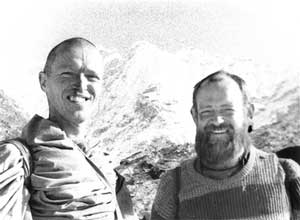 |
| I reflected on the significance of our crossing of the River Son. To the west the river was the Bihar state boundary and in crossing it and then turning left we would be leaving India's poorest and most lawless state for the orderly Uttar Pradesh. The significance of the crossing seemed more than that though. The following night was the full moon and that was precisely half way through our six months of pilgrimage. We had actually managed to get half way, despite all the difficulties. Not only that, but we had learnt from it, and now the pilgrimage seemed to be flowing more like the river. We were taking things in our stride and perhaps the next three months were going to be easier than the last three. The ferry was a large rowing boat with two men at the oars, waiting at the shore. We crossed for a rupee each, with three local passengers. The two of us sat in the back: me with my hand trailing in the water, taking it all in - the wide river, the woodland on the further shore with the vast cliffs rising behind, which got higher the nearer we got - and Ajahn Sucitto murmuring a mantra, looking down at the light playing on the water as it flowed by. Ajahn Sucitto: Everything seems possible on a fresh sunny morning. The morning was radiant: a cobalt sky shone down on dry forest, sun-bleached grasses with long feathery seed heads, and stands of pale yellow bamboo. The Son river on our left was brown and brawny like Gandak, pouring down to the Ganges with vigour. It carried so much silt in its purposeful stride that it was like molten chocolate. 'You are in U.P. now,' said a man on a motorbike an hour or so's walk due west. 'U.P. is a rich state, there will be no problem getting food; just ask anybody.' (But a good bhikkhu shouldn't ask for anything!) Soon there was a settlement: a large single-storeyed house with a yard, and a few men sitting round in it. Just outside was a smooth rock with a swatch of red paint on it which a tall bamboo shoot stood over bearing a scrap of cloth like a flag. 'That's the house shrine,' I told Nick. We sat nearby and one of the men came out to greet us in an indistinct dialect. He asked what he could do for us and I asked for water. He returned with two beakers and some jaggery sugar and invited us to sit. I explained that we were pilgrims and he nodded... that I was a disciple of the Lord Buddha, that we were walking on foot and had walked 900 kilometres from Nepal. He made friendly noises and went back to the house. Things were moving slowly, but we heard them talking about rice; then a couple of plates came out. As the sun moved they beckoned us into the shade and brought out a little dish of curd. But as an hour went by, nothing more seemed to be happening. Of all patterns, the one that we read into human actions is the most deceptive. We chanted the Metta Sutta anyway. Finally one of the men came up and started talking about food... I listened carefully... what was he saying? But at the mention of food, Nick burst in, nodding vigorously: 'Ahchaa! Ahchaa! Yes! Yes!' I grimaced; that was the wrong answer. What the man had just said was: 'Have you eaten already? Do you have your meal with you?' 'Remind me to keep my mouth shut in the future, bhante,' said Nick as we munched some biscuits in a forest glade ten minutes' walk away from the house where he'd just refused a meal. He'd purchased a few provisions as a stand-by in Bhaunathpur a couple of days previously. It wasn't great fare, but it filled a hole. Although we were a bit low on nourishment, it was not far to Chandni, where the map showed a broad road cutting through the scarp. We'd find a nice place to camp in the middle of the afternoon. | But (we should have known by now) there's nothing more uncertain than an Indian map; at least one of an uninhabited area. We walked around the little hamlet of Chandni, went past it, and then retraced our steps along the river bank: no road. The scarp rose up like a wall over 1,000 feet high. Although we felt washed out, it would be better to scale it today rather than after an all-night vigil. We found a young man herding a few cows laden with packs up a drovers' trail. He said it went towards Soman on the other side of the scarp. So we set to it. I was gasping within minutes, but the pain in my legs, feet and chest told me that I'd better not stop. This was no time to start being reasonable. We soon left the slow tinkling of the cattle behind. Towards the crest of the scarp, we scrambled off the trail and up a crag to the right. We heard them clinking past minutes later. Then we were alone. We were on a rocky summit 1,300 feet above the plateau. The black rock was strewn with yellow leaves from a scattering of thorny trees. Their gnarled silvery trunks reached into the deepening blue sky. Bleached bamboo and tall whitened grasses stuck up through scraps of soil, and it was all very quiet. I had enough momentum left to unroll my mat and sleeping bag and flake out on a level of rock. It was probably far enough from an edge if I rolled over, but at the time I was past caring. When I woke up, it was dark, but pale smoke and a nearby glow indicated that Nick was making tea. He was at his best in the wilds in the evenings. Out would come the round-bottomed pot that he'd bought in Chatra; then he'd silently build a ring of stones and gather twigs and leaves, get a fire going and put the water on. I'd start searching for fallen branches - wood wasn't plentiful, but what there was was dry as a bone, and I'd set a good supply near him. Then I'd build a shrine out of rocks - overlooking a view and near enough to the fire to allow us to stay warm. Generally we'd talk together over tea before offering candles and incense. It was a good rhythm and felt like a natural prologue to the silent sitting: the big space and slow unfolding of the simple activity of a camp helped unwind the tensions of the day. |  |
| That night opened into vast simplicity. The forested hills dissolved to darkness and merged into the sky; Son snaked below us, glowing in its own power and garlanded with pale sandbanks. I could see it issuing from the misty curve of the horizon and steadily carving its way through the hill mass. In all those hundreds of square kilometres of land only three tiny pricks of light spoke up and they soon ceased. Then there was only our candle to echo the blazing moon. Such aloneness is calming; it's so vast that you're part of it and the mind rests in humility. Nick: Between the dry lands were two wide valleys irrigated by dams and canals like the one we slept beside. Water was very important in this landscape. Where they had it, in the valleys, the land was turned into fertile flat oases of fresh green wheat, chequered with coloured flowering patches of blue flax, yellow rape and white chickpeas. The fields were dotted with small thatched shelters and scarecrows made from a cross of wood, an old shirt and a hat; and every so often there were villages of orange clay houses. The landscape looked so beautiful after the dry hills: the speckled colours gave it the look of an impressionist painting of Provence at the turn of the century. The dry land had its own beauty, though, a haunting and desolate emptiness in which just a few poor peasants eked out a living. I remember one old couple sitting by a house. Ajahn Sucitto asked for water for our bottles. The old man was proud to be able to offer it but the old women looked peeved. It occurred to me that it would have been her that had carried it from the distant well we could see at the bottom of the hill. Two days later we came down out of the hills on to the crowded Ganges plain again and there was another river. We had been for alms in a winding village called Amra and were walking on along a small road which led to Varanasi. I had spotted the river on the map and thought it might make a good place to bathe. It might even be deep enough to swim. When we came to this river it could not have been more ideal. It was not wide but it was deep, clear, slow-moving and overhung by trees. There were steps leading down to a gap in the reeds where the locals must have regularly bathed. It was mid-afternoon and the perfect time to take a dip. We were tired, dusty and hot and, incredibly, there was absolutely no-one about. There was not a doubt in my mind, I had suggested we take a bath and was down the steps before Ajahn Sucitto had taken in what was happening. I stripped off to my underpants and swam out into the centre of the river and called to Ajahn Sucitto that it was lovely. He was not interested. Instead he moved off and sat under a tree to wait for me to finish. I could not leave it at that, though, and after swimming a few lengths I tried getting him to come in again - 'it was great, why didn't he come in?' - but, he remained sitting upright under his tree and from the way he said no I got a strong impression of disapproval. The whole incident must have taken only fifteen minutes but I learnt a lot from it. That was because as we went on we discussed it - just the fact that we did that was a change from the earlier part of the pilgrimage. To him my bathing had seemed irresponsible. We had agreed that morning that we were going to walk to Varanasi and try to get there by the next day. To one with his dogged character an impromptu swim, even if it was our first opportunity for three months, was a frivolous deviation from our purpose. Talking it over I discovered that if I had told him in the morning that we may have the opportunity for a swim later it might have been different. It was the unexpectedness as much as anything which had really been the problem. That, in fact, had been deliberate, I had been saving it for a surprise! He later told me that my scamper down the steps and plunge into the water reminded him of the actions of one of those goofy red setters which their owners despair of. Ajahn Sucitto: That day, the day before we were to arrive at Ramnagar, a man hollered at us the familiar 'Kaha ja ra hai?' as we lumbered along. He was the proprietor of a sugar mill, and an example of the energies that his product was capable of. As pilgrims to Varanasi we must stop for a while and drink his sugar-cane juice, freshly-pressed; and here were fist-size balls of jaggery still warm from the pan where the juice was simmering. He couldn't stop talking and pressing samples on us - 'Liking? Liking?' - until we were nearly reeling from eating and drinking the stuff. Even then, pressing lumps of jaggery onto Nick and filling our canteens with litres of the juice he followed us, ripping hard stalks of sugar cane with his teeth to give us chunks of the sweet sappy core. So we could hardly stop chatting (and next morning too) and the flow deposited some of our conflict. And things felt better afterwards. There was no need to feel bad or to figure out what to do, but some of the mud had got dumped, and there was some clarity and recognition of where our journey needed to go. We suddenly understood that we were living in different worlds. The actuality of his walk was made up of all kinds of details, of what games the children were playing, of how the crops were cultivated or the method of making pots, that I hadn't seen. And I was astounded that he hadn't noticed things like an incredible Hanuman shrine built into a telegraph pole: we had walked right past it. Everything gets measured in terms of oneself. The mother, conduit and reservoir of all the conflict was, why can't he be normal, like me? I could learn a handful of Hindi words and phrases every day while walking along, without even pushing it. But Nick would interrupt me in a conversation with mispronunciations of Hindi words that I'd corrected him on a dozen times. He couldn't even repeat a foreign word after me as I said it. Then again: how could he chant so badly? For me to read a line of Pali three times is to know it, and anybody can chant in tune, can't they? But after fifteen years he was still having problems with reciting the Refuges and Precepts. My immediate reading was that he thought it was a waste of time and was putting no effort into it; so that was off-putting. Then I noticed how much effort he really was putting into it. The fact was that the glue of his mind, wonderfully effective when it came to reading landscapes and maps, could not stick words, no matter how much hammering and heat were applied. And when I realised what we all should know, think we know, but don't know, that 'This is another person,' something was crossed over, and the perceptions changed. My feeling for the man, and for whatever he had to carry deepened. India... the vagaries of life on the road... supporting a monk - what was he working his way through? Couldn't I help him along? I could try... and forget again. And in the course of that, empty a little more of my self into the Way It Is. 'When you write about this, bhante, make sure you mention all my faults...' Actually it seems I have described my own even more accurately. But that's the humbling fact of this journey: we fare on in our own current, a stream that floods and saturates the world. And it is not always so grand. But the pilgrimage is not about aiming to arrive at a new world; any appearance or possibility is based on our repetitive personal biases. The journey is to let go of all possible worlds. So it is not onwards we go, but on, as if in a torrent which cuts down through the bedrock of habits, personal assumptions, opinions and wishes. But somehow flowing on.
| ||
