|
October
2007
2550 Number 81
The Forest Sangha is
a world-wide Buddhist community
in the Thai Forest tradition of Ajahn
Chah
Pushing at the edges
An interview with Ajahn Upekkha
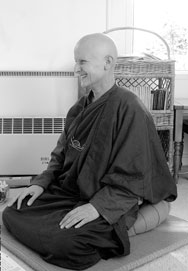
When I came to the monastery I had a sense of urgency because my sister, just one year younger than me, had died. I cared for
her through that process. She showed me that I had work to do, this was
her gift. I didn’t want to die the way she died, with terror and
fear. In the end, bless her, she found peace. Her death accelerated my
spiritual process. I had been taking my time, then wham – I realized I didn’t have time.
I also had a strong motivation to help people. As a child I wanted to
create a world of beauty, of love and kindness. From very young I was
living in an ugly place. I am from a big family, being number twelve
out of fifteen (two died). I was separated from my family to go to an
orphanage. I didn’t want anybody to feel the deprivation I
experienced. The orphanage could not offer better than it did, nobody
was to blame. Wherever I went I had the motivation to create abundance.
When I arrived at Amaravati my commitment was not to a community or to
a religion. It was about realizing the Truth; being free from fear.
I’ve found it challenging because I had strong reactions to
religious orthodoxy. Some people are insistent about how to hold the
rules and what we should or shouldn’t do. I struggled because I
find community life is alive when we pay attention to individual people
not just to a system of values that looks good from the outside. That
was my battle; between what it looks like, and what is important for us
as individuals and as a group.
The fortnightly Vinaya recitation, for example, is like a foreign
language to me. If I want to investigate desire, sexuality, attachment,
anger, it’s not by such recitations that I will learn about them.
It’s in my daily life – using Luang Por Sumedho’s
teaching – by reflecting on Dhamma, by being mindful and aware,
that I learn the most. I find that reciting rules, or focussing more on
them, can shame you if you don’t understand what Vinaya is all
about. You can feel guilty because you are eating too much chocolate,
or are attracted by someone. Whereas, in fact, it’s a process of
discovery of what it is to be a human being. You have to understand
what the senses are, the process of feeling – and experience it
all, neither rejecting nor indulging in it. What the Vinaya shows me is
that when I have sense desire, for example, I can reflect, ‘this
is how it feels when something is not available’. Then I see,
‘Oh, believing that something is missing is causing me
suffering’, rather than the experience itself. If I don’t
allow myself to feel, out of fear of the Vinaya, then I’m not
doing the real work. I never wanted to be part of an institution.
Rather, I want to use rules as tools to help me understand who I am,
and to detach myself from wrong views and opinions.
At first as a nun it felt like I was in military training. I thought
‘Where is love? Where is kindness? Why must the discipline be
harsh?’ That’s something I could not accept, with my
passion to create a world of beauty and love. I came here, because of
the Buddha’s teaching, to find wisdom and joy in life. Though
this is not based on external conditions, in the beginning of the
training we do need some support of kindness from outside. That was
something I felt was missing.
It’s a strange feeling coming to the Sangha when you have been an
independent woman. I had my job, I had my flat, I was divorced. I
travelled freely around the world. I was passionate about independence
yet here, at that time, I was not allowed to go out of the monastery
alone down the lane. This was something I couldn’t understand,
and at first my objections were dismissed. It felt painful but prompted
me to stand for my truth. I would keep on pointing out what would
support the nuns.
So, my twenty-two years involved pushing at edges to find what works
for women. And Luang Por responded to that by explaining that little by
little he and the monks were learning to understand women. I
didn’t know anything about men either. I had brothers, I had a
father, but I learned more about men in the monastery. I heard their
reflections and they shared their space with me. Over the years
we’ve been having dialogue; when we listen to each others’
experience then we can support each other. Luang Por made space for it
because he wanted to learn. I’m grateful to him for enabling
women to be ordained here. He has said he would support us in
establishing independent places. He wants to support women; that is his
gift and his wisdom. He took that risk and not everybody wants to take
such risks.
What do you think the risk is in supporting women to live this life?
I think it was risky for him in relationship to Thailand because he is
committed to Ajahn Chah, and to the Thai community. In the first ten
years they were watching how we would behave, and he didn’t know
what we would do. So he did take a risk. But I think the result is
great. He has said he has no regrets and that it is a benefit for the
monks’ community to have nuns. I have gratitude for Luang Por and
the monks’ community; and for the nuns who had to bear with me
for the last twenty years with my passionate character. I’m
grateful also for the laypeople who support us; we are able to practise
here because of their trust and support.
What changes have you seen in the nature of support from laypeople, and
in the type of people who come to the monastery?
Initially mostly Thai and other Asian people supported us. As the years
passed by, more English and European people came through. They were
interested in meditation but didn’t know much about alms
mendicants. But they did learn. It is clear that we can go anywhere and
we will be supported by Western people. That’s thanks to Asian
people who supported us from the beginning; without them we could not
have created this community. We started with nothing much at Amaravati.
Everything was broken, just rice and beans to eat, and in the winter
nobody wanted to come because it was too cold. I particularly remember
Mr Tan Nam and Khun Lim bringing blankets and cooking food for us. If
they hadn’t sustained us from the beginning we could not have
stayed. And now it feels important – and, thanks to that support,
possible – to create something independent for women as the next
stage in the development of the nuns’ community.
What form might that take?
I’d like to have a hermitage to give the opportunity for women
who want more time in retreat, a small place with no more than six kutis (huts). It is said that a good-sized community is when you can all sit
around a fire. I have never experienced a small community. Even in my
family I was in a big group. This is my last longing. Maybe I will
experience it before dying, maybe not. But I feel sure that in the
future there will be a monastery for nuns. The ground for it has been
prepared over the last few years. Though some of us feel not quite
ready….
What would it take to be ready for it?
I think more trust in one another. We can’t wait for someone
perfect. We have to support someone to do her best. If we don’t
empower her, then it will not happen. Everyone has something to offer.
If we focus on having to ‘look good’ – comparing
ourselves with the monks because of the wider support they have –
it weakens us. This denies our particular strengths. There is not yet
the trust to recognize and accept those strengths.
We can bring our particular understanding of life – of what
suffering is all about – because many of us have been through so
much ourselves. We can reach and help a wide range of people. We have
an aspect of acceptance, we embrace all, we don’t separate
ourselves off. This can be a limitation too because we can become weak
by depending on other people. But when we are able to stand on our
vertical, we don’t separate ourselves from the world, we
understand it. I think this is a gift women have.
My experience through these twenty years is that I always received what
I needed. When I felt low, someone always gave me a hand, a smile, a
cup of tea. I always had support to take the next step. I came here
because I trusted intuitive awareness - my inner voice saying
‘This is your place’. I arrived five years after the
nuns’ Sangha was established. Later, the people who had been with
me all disrobed. This was not necessarily because of a lack of faith,
or misunderstanding of the Dhamma, or because they were too weak, or
whatever. I respect them for trusting their intuition: for them it was
time to go. We are all on the spiritual path of one form or another, so
I find it important that we live true to our life. Trust and faith are
essential; they make us powerful.
back
to top
©The Forest Sangha
Newsletter | site
map | contact
|
|