|
October
2007
2550 Number 81
The Forest Sangha is
a world-wide Buddhist community
in the Thai Forest tradition of Ajahn
Chah
About this issue
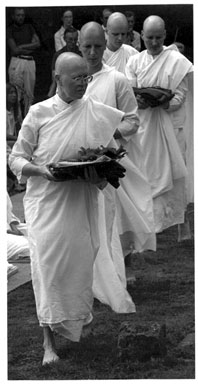
Ordination of the first four siladhara
Emptiness here, Emptiness there
but the infinite universe stands
always before your eyes.
This verse from Sengtsan seems to capture the paradoxical nature of
the teaching that the Buddha used in myriad forms to point to that
which is beyond description. Luang Por Chah would echo this again and
again, compassionately leading, guiding, and prodding his disciples
towards awakening.
By some mysterious coming together of circumstances our nuns’
community has come into being and has become part of that current. This
year sees the completion of the 25th vassa since the establishment of the Siladhara Order. There will be a
celebration of the occasion at Cittaviveka on November 3rd (see the
Grapevine for more details). This issue is dedicated to the
anniversary. The nuns’ community coordinated the material in a
collaborative effort with Sister Cintamani compiling and editing the
material.
The origins of our nuns’ order lie in Pat Stoll’s request
to Ajahn Chah that she be able to live as an eight-precept nun. In 1979
Ajahn Sumedho gave the Eight Precepts to Pat Stoll, Françoise
Reynaud, Katie Cockburn and Mary Peacock at Cittaviveka, naming them,
respectively, Sr Rocana, Sr Sundara, Sr Candasiri and Sr Thanissara.
After a few years of practising in that form they sought to live more
fully as alms mendicants. In 1983 at Ajahn Sumedho’s initiative
and with permission from the Thai Sangha they received the Going Forth
(entering the second vassa that year). In 1987 Sr Rocana died while on
pilgrimage in India. In 1991 Thanissara disrobed and along with
Kittisaro established Dharmagiri Buddhist Hermitage in South Africa.
These are some of the bare facts. The story – or better, stories
– of the evolution of the Siladhara Order are as varied as those
who recount them.
Many people have been, and continue to be, involved in and affected by
the evolution of this community. The whole is larger than the sum of
the parts. We feel gratitude and respect for Luang Por Sumedho. As well
as being our preceptor, he saw to it that we had requisites in
abundance and his repeated encouragement to wake up has been
invaluable. We thank our bhikkhu brothers – notably Ajahn Sucitto, abbot of Cittaviveka for the
past 16 years, who formulated our training structures and has been
committed to the support and evolution of the double community of monks
and nuns. Each of the sisters has, in her own way, helped to shape and
breathe life into the form that we see today. We reserve special
appreciation for Ajahn Sundara and Ajahn Candasiri on the occasion of
their 25th vassa and for being here from the beginning of this
community. Many others have encouraged us over the years with countless
gestures of support: material, practical, and above all, with their
faith in this Way from which we can all benefit so much.
We asked the first nuns – Aj. Sundara, Aj. Candasiri, and
Thanissara – to reflect on their years in the Order. Some common
themes and shared experiences emerge in their reflections, as well as
divergences. These present no singular history but histories born of
reflection, recollection; subjectively felt and often publicly lived.
Ajahn Sucitto offered an account of some of his experiences in helping
to establish the nuns’ system of training, and he describes the
complexities of the context in which it evolved.
We asked other senior nuns to contribute their perspective. Ajahn
Upekkha speaks with her distinctive voice on realizing the Truth, and
on fearlessness, from her many wholehearted years living in the
community. Ajahn Thaniya after eight years as the senior nun of
Chithurst writes of the evolution of the nuns’ community within
the mixed community and of the beginnings of Rocana Vihara. She
describes the rich territory that opens up for exploration. Ajahn
Kovida writes of her journeys to Thailand and Burma, the practices she
engaged in and how they support ongoing inquiry. The report on the Hamburg Congress on Buddhist Women illuminates international concern about the role of women in Buddhism.
And the poetry by several of the senior nuns speaks perhaps more
directly from the heart of experience.
It is inevitable that some of the struggles of the integration of a new
community within an ancient tradition form part of the picture of the
nuns’ experience. Clearly the situation has presented challenges
for everyone: monks, nuns as well as the laity, as each delicately
navigates the interface of different cultures and conditioning. It is a
slow and continuing evolution where the hard work of all contributes to
the consolidation of the nuns’ community and to the planting of
this tradition into Western soil.
The style of presentation in this issue may be different than is
customary. This is a tapestry woven out of many threads. Luang Por
Sumedho repeatedly encourages us to open to whatever arises. So within
the territory of what it takes to wake up, it is important that all of
this has its place.
Ajahn Thanasanti
back
to top
©The Forest Sangha
Newsletter | site
map | contact
|
|